How to wear crystal bracelets with a watch comes down to two decisions: which piece should lead visually, and whether they can share a wrist without getting in each other’s way. Start with the watch you actually wear, then try one bracelet beside it or on the opposite wrist. Look at the combination with your usual sleeves, move your arm as you normally would, and edit until it feels considered rather than crowded.
A slim watch and a patterned bracelet can work together; so can a more substantial watch and a quieter strand. What matters is the relationship between the complete pieces, including their color, scale, fit, and points of contact.
Start With the Watch You Already Wear
A watch is more than a metal color. Its case, strap or bracelet, dial, and overall presence set the frame for whatever sits nearby. A broad case or bright dial may already be the focal point. A restrained watch can leave room for a crystal bracelet with more visible pattern or color.
Set the watch beside a bracelet before putting either on. Notice the watch's warm or cool details, the contrast of the beads, and whether either piece has projecting accents. Then put them on. A pairing that looks composed on a tray may behave differently when you reach for a bag or bend your wrist.
Same Wrist or Opposite Wrist?
On the same wrist
Wearing a bracelet beside a watch creates a single, deliberate focal area. Begin with one bracelet. Try it on either side of the watch, toward the hand or farther up the arm, and see which position leaves the watch easy to read and operate.
Check the pairing with your wrist relaxed, then while turning a doorknob, typing, and pulling on a sleeve. If beads repeatedly meet the case, crown, clasp, or metal band, move the bracelet or separate the pieces. Avoid forcing a tight arrangement simply to keep both on one wrist.
On opposite wrists
Separate wrists give each piece its own space and can reduce direct contact between them. This is often the simplest choice when a watch has a substantial case, a bracelet has a prominent accent, or the two feel busy together. A watch can carry the stronger visual weight while a softer bracelet provides a small counterpoint.
Stand in front of a mirror with both arms visible. If one side seems unusually heavy to you, soften the bracelet's color or choose a quieter design; do not add another piece merely to achieve mathematical balance.
Decide Which Piece Leads
A polished pairing usually has a clear focal point. If the watch has a distinctive dial, strong strap color, or broad case, let the bracelet support it. If the watch is spare and understated, a bracelet with gentle pattern or a warmer color can take the lead.
Transparent-looking beads may seem lighter than strongly patterned ones, while a small metallic accent can draw the eye more than several pale beads. If you notice two competing highlights before you see either piece clearly, simplify one of them.
Balance Bracelet Scale With the Watch
Compare proportions rather than searching for an exact bead diameter. A watch with a delicate profile may pair naturally with a quieter strand; a more substantial watch can also sit beside a bracelet with a clearer presence if the colors remain restrained. The aim is to make the two pieces legible, not identical.
One bracelet is enough for most watch pairings. A second bracelet changes the question into a fuller stack: each additional piece adds color, movement, and another possible contact point. If you want to explore two or three bracelets together, the separate crystal bracelet stacking guide covers that decision in depth. Here, keep the watch-and-bracelet relationship in focus.
Coordinate Metals Without Matching Everything
Repeating a metal tone can make a pairing look cohesive. Gold-toned watch details can echo warm plated accents; silver-toned hardware can continue a cooler palette. But deliberate mixed metals can be just as refined. If the watch and bracelet differ, let one tone dominate and repeat the other quietly in a ring, earring, or small watch detail if that suits your style.
Read product materials before describing an accent. A gold color does not establish solid gold, and a silver color does not establish sterling silver.
A warm-toned direction
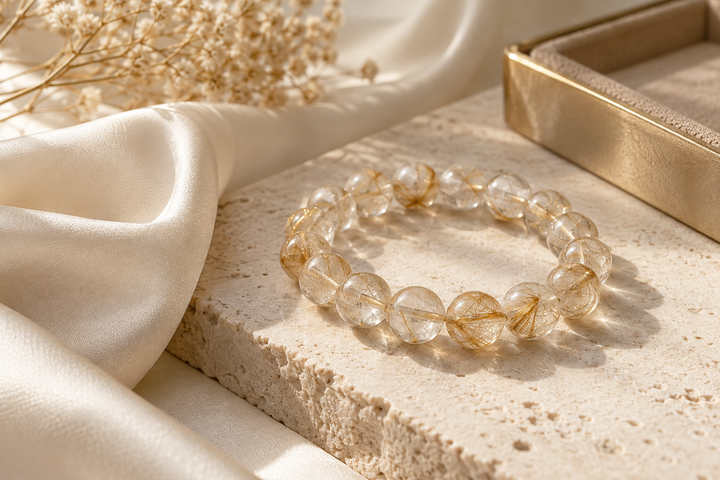
The Aurelia Golden Balance Bracelet is listed with Cherry Blossom Agate, Citrine, and 18K Gold-Plated Copper Accents. Its blush, golden-yellow, and champagne tones offer a warm example beside a watch with gold-toned details or a neutral leather strap. It can also introduce warmth beside a cooler watch; the mixed-metal choice is stylistic, not an error. Do not assume the bracelet and a watch have been tested together or that their surfaces cannot mark one another.
A cool-toned direction
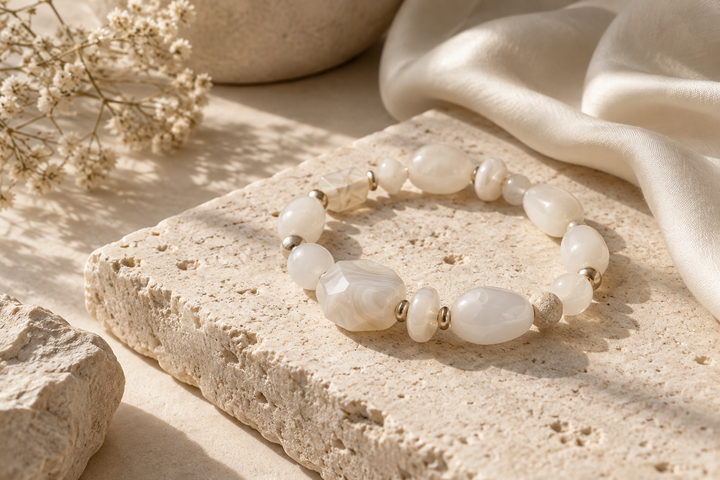
The Lunelle Moonlit Mist Bracelet is listed with Clear Quartz, Tianshan Cui Quartzite, and Silver-Plated Accents. Its clearer, cooler palette offers a different relationship with a silver-toned watch, a pale dial, or a dark strap. Compare the actual watch and bracelet on your wrist before deciding which side to wear them on.
Use Color as a Quiet Connection
Color can link two pieces even when their metals differ. A cream dial can speak to pale or translucent-looking beads; a warm brown strap can sit comfortably beside blush and golden tones. One shared light or warm note may be enough, especially when the rest of the outfit is simple.
Check the pairing against the clothes you wear often. A bracelet that reads softly beside an ivory cuff may stand out more against navy. For broader everyday wardrobe choices, see the everyday crystal bracelet guide.
Give Sleeves and Cuffs Their Say
A watch and bracelet occupy more space under a sleeve than either does alone. With a fitted shirt cuff, fasten the cuff and move your arm before leaving the house. If it catches on a bead or pushes the watch down toward your hand, wear the pieces on opposite wrists or choose only one for that outfit. Do not press the bracelet beneath a tight cuff to preserve the look.
Looser knits and open sleeves leave more room, but they can hide the bracelet entirely. A little visual breathing room around the watch face and bracelet details often does more for the look than adding another accessory.
Check the Pairing During an Ordinary Day
At a desk, notice where your wrist meets the surface and whether the bracelet shifts against the watch while typing. When carrying a bag, check for catches at the strap or clasp. If the pairing needs constant adjustment, divide the pieces between wrists or remove the bracelet for that task.
Fit matters as much as appearance. Measure your actual bare-wrist circumference where the bracelet will sit and follow the SoftLumina Bracelet Size Guide. Do not add a fixed extra allowance because you plan to wear a watch; the guide already accounts for fit. If your measurement falls exactly between sizes, choose the larger size. A different wrist may measure differently, so check the wrist you intend to use.
Know When to Wear Just One
A watch may need the wrist to itself during tasks involving repeated contact, pressure, water, or strenuous movement. If beads or accents knock against the case, the most refined decision may be to remove the bracelet.
After wear, put the bracelet away separately rather than leaving it wrapped around the watch. Follow the directions for the finished piece, including its stones, elastic, and plated accents. The crystal bracelet care guide explains gentle cleaning and storage without treating every material alike.
Frequently Asked Questions
Can I wear a crystal bracelet with a watch?
Yes, when the combination suits your style and feels practical on your wrist. Start with one bracelet and check how the pieces look and move together. If they repeatedly touch or catch, change their position or wear them on separate wrists.
Should I wear the bracelet on the same wrist as my watch?
You can, but it is a choice rather than a requirement. Try the bracelet on either side of the watch and keep the watch face, crown, and clasp accessible.
Which side should the bracelet go on?
There is no prescribed left or right wrist. Use the side that works with your watch habit, sleeves, and movement. If the bracelet sits on the watch wrist, test both positions around the watch rather than following a fixed ordering rule.
Can I mix gold and silver tones?
Yes. Matching tones create a unified look, while intentionally mixed tones add contrast. Keep the overall palette considered and check the actual product descriptions so plated details are not mistaken for solid metals.
How many bracelets should I wear with a watch?
Begin with one. Add another only if it has a clear visual role and the pieces remain practical in motion. A watch already contributes to the composition, so more bracelets do not automatically make it better.
How do I keep the combination from looking crowded?
Let the watch or bracelet lead, use a restrained color connection, and check the look with your sleeves and other jewelry. If details disappear into one another or the pieces need constant adjusting, remove one or move the bracelet to the opposite wrist.
A Pairing That Feels Like Yours
Learning how to wear crystal bracelets with a watch is less about obeying a placement rule than noticing the relationship between two pieces you enjoy. Choose a focal point, allow room for each design to be seen, and pay attention to contact during the day. For a warmer direction, explore the Aurelia Collection; for cooler, light-filled palettes, browse the Lunelle Collection. Let the watch you already own guide the final choice.